MCP Guardrails
An agentgateway ExtMcp guardrail sidecar that wraps an ONNX-based PromptGuard-2 scanner (prompt-injection detection via the gravitee-io/Llama-Prompt-Guard-2-86M-onnx model) and an Invariant Guardrails-style rule engine (cross-call toxic-flow / loop detection) behind the agentgateway ExtMcp gRPC contract.
The sidecar is fail-closed by default, listens on plaintext HTTP/2 (h2c)
gRPC on :9001, and is driven by agentgateway's mcp-guardrails processor on
both sides of every MCP exchange — request params scanned as the TOOL role,
tool output scanned as the ASSISTANT role (the indirect-injection frontline),
with an optional cost-bounded AgentAlignment LLM as a second stage gated on
first-stage HUMAN_REVIEW.
Current version: v0.4.0.
Project scope
This project is a pure guardrail: detection, blocking/mutation verdicts, and audit. Deliberately out of scope:
- Rewriting / normalisation policies (canonicalisation, paraphrasing, content transformation as a policy primitive) are the job of other agentgateway modules. The one exception is the built-in redaction capability, which masks secrets/PII in otherwise-forwarded payloads.
- Network isolation is the deployer's responsibility. The sidecar binds
plaintext h2c on
:9001with no authentication of its own; protecting the gateway↔sidecar path (KubernetesNetworkPolicy, mTLS via a service mesh, namespace segmentation) belongs to the platform, not this repo.
Architecture
sequenceDiagram
    autonumber
    participant Agent as MCP Agent (LLM)
    participant GW as agentgateway
    participant Sidecar as ExtMcp Guardrail (sidecar)
    participant PG as PromptGuard ONNX
    participant INV as Invariant Engine
    participant MCP as Upstream MCP Server

    Agent->>GW: tools/call (JSON-RPC)
    GW->>Sidecar: CheckRequest(McpRequest)
    Sidecar->>PG: scan(params, role=TOOL)
    Sidecar->>INV: record(tool, args) + evaluate()
    PG-->>Sidecar: ScanDecision
    INV-->>Sidecar: ScanResult
    Sidecar-->>GW: McpRequestResult{pass|mutated|error}
    alt allowed / mutated
        GW->>MCP: forward JSON-RPC
        MCP-->>GW: result
        GW->>Sidecar: CheckResponse(McpResponse)
        Sidecar->>PG: scan(result, role=ASSISTANT)
        PG-->>Sidecar: ScanDecision
        Sidecar-->>GW: McpResponseResult{pass|mutated|error}
        alt allowed / mutated
            GW-->>Agent: result
        else error
            GW-->>Agent: JSON-RPC -32001
        end
    else error
        GW-->>Agent: JSON-RPC -32001
    end
Container-internal flow (every gRPC call traverses this pipeline):
flowchart TD
    subgraph Server
        GRPC[grpc.aio server<br/>:9001 h2c]
        SVC[ExtMcpServicer<br/>CheckRequest / CheckResponse]
        GRPC --> SVC
        SVC --> ENG[GuardrailEngine]
    end

    subgraph Engine
        ENG --> EXT["extract_text + scan_windows (balanced head/mid/tail)"]
        EXT --> RX[RegexScanner<br/>hidden-ascii / PII / secrets]
        EXT --> PG[OnnxPromptGuardScanner<br/>PromptGuard-2]
        EXT --> INV[InvariantEngine<br/>trace record + evaluate]
        RX --> AGG
        PG --> AGG
        INV --> AGG
        AGG[DecisionAggregator<br/>fail-closed]
    end

    subgraph Response-only
        AGG -. second stage .-> AA[AgentAlignment<br/>only when first stage<br/>flagged HUMAN_REVIEW]
    end

    AGG --> DEC[Decision]
    DEC --> SVC
    SVC --> GRPC
Component map
The interactive diagram below maps the sidecar end to end: the double gate
(CheckRequest / CheckResponse) through agentgateway's ExtMcp contract, the
first-stage scanners (Regex, PromptGuard-2 ONNX, Invariant rules) merging into
the fail-closed DecisionAggregator, and the evidence path (redaction,
opt-in AgentAlignment review, tamper-evident audit + OTel).
Open the interactive diagram full-page Static preview
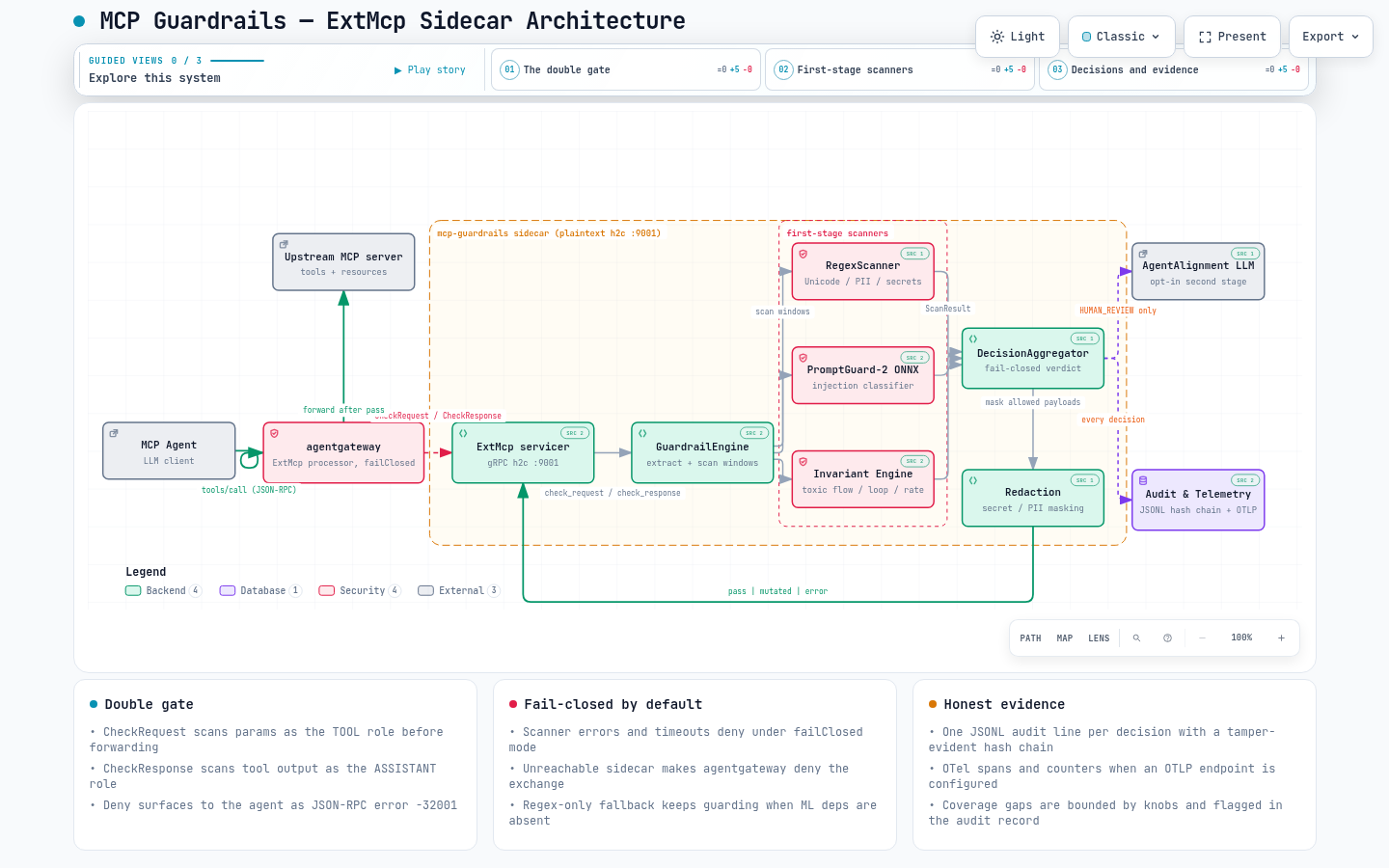
It is generated with Archify from a typed
specification pinned to a repository revision
(docs/_assets/architecture.json), so every node carries verifiable source
evidence.
Relationship to agentgateway
agentgateway invokes the sidecar twice per MCP exchange through the ExtMcp
gRPC service:
| RPC | When agentgateway calls it | Sidecar's job |
|---|---|---|
CheckRequest |
Before forwarding the agent's request upstream | Scan params as TOOL role; record + evaluate the toxic-flow trace |
CheckResponse |
Before returning the upstream response to the agent | Scan tool output / tool descriptions as ASSISTANT role (indirect injection) |
Both RPCs return one of three states via a protobuf oneof:
pass(Pass) — forward the payload unchanged.mutated(bytes) — replace the payload with the supplied raw JSON bytes (emitted by the redaction stage).error(AuthorizationError) — deny. agentgateway surfaces this to the agent as a JSON-RPC error (-32001); since agentgateway v1.6 a deniedtools/callis instead mapped to a tool-error result (isError: true) with generalised text for 2026-07-28 clients.
The vendored contract lives in proto/ext_mcp.proto (from
agentgateway/agentgateway, crates/protos/proto/ext_mcp.proto).
Where to next
- Getting started — run the sidecar, deploy on Kubernetes, wire agentgateway, verify.
- Guardrails overview — the decision pipeline and every guardrail in detail.
- Configuration — the complete environment-variable reference.
- Security model — threat model, failure modes and known limitations.
- Development — tests, proto sync, release process.